Dee Why Beach
Dee Why Beach sits on the eastern edge of the Dee Why suburb, about 18 kilometres north of the Sydney CBD (central business district). The beach runs for roughly 1.2 kilometres, facing open ocean to the east and forming a crescent between the Long Reef headland to the north and the Dee Why headland to the south. Dee Why Lagoon, a protected coastal wetland, sits behind the beach to the north and separates it from Long Reef Beach further along the coast.
History
- The Garigal people lived in the area before European arrival; a shell midden at the southern end of the beach is evidence of this.
- The origin of the name "Dee Why" is unconfirmed. The earliest written record is a field-book entry by surveyor James Meehan dated 27 September 1815, noting "Dy Beach." Theories on what "Dy" referred to include a marker Meehan used elsewhere in his surveys, an indigenous term, or the shape of the lagoon.
- European land allocation began in 1819 with a grant to shipbuilder William Cossar.
- By the mid-19th century the Jenkins family held most of the land; Elizabeth Jenkins later passed her share to the Salvation Army, who used it for religious and farming work until subdividing and selling the plots in 1911.
- Local bridges and tram extensions opened the area up through the 1920s, and growth continued with later bus connections and a residential boom after World War II that turned Dee Why into a commercial and recreational hub.
Beach Characteristics and Facilities
- The landscape runs from urban parkland in the south to conservation zones in the north, where dunes and the lagoon take over.
- The sand forms a broad, gently sloping bar, with waves suited to beginner and intermediate surfers
- A tidal environment shifts the sand contours and can throw up rip currents, so swimmers are advised to stick to patrolled areas.
- A concrete rock pool sits on the southern sandstone shelf near the surf club, built in 1915 and later expanded by the council — a calm, enclosed swim option at most tides.
- The promenade along The Strand is lined with Norfolk Island pines, fronted by cafes, restaurants, shops, and apartments. The northern end connects to a walkway and picnic reserves.
- Facilities include public toilets and changing rooms, showers, a surf lifesaving club, playgrounds, picnic tables, electric barbecues, paved paths, parking, and nearby bus stops.
Facts and Curiosities
-
The black swan is an emblem of Dee Why, a reference to the large flocks that once lived on its lagoon.
In 1925, someone painted a swan on the pavement of Howard Ave, where it remains to this day. For over a century, anonymous artists have kept the tradition alive, repainting the emblem whenever it begins to fade.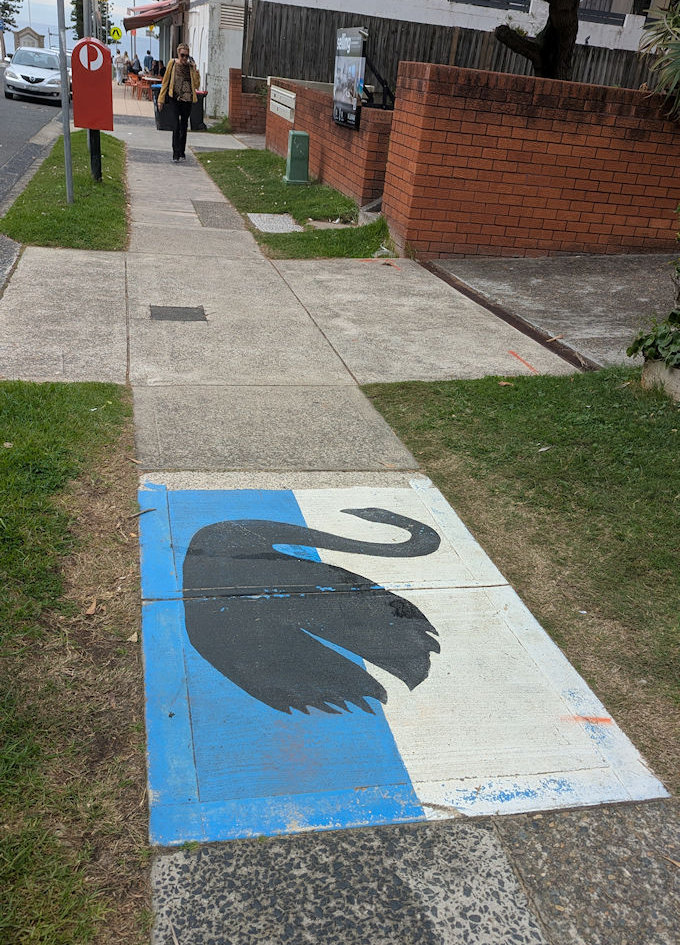
- Dee Why Lagoon, also called the Dee Why Park RSL wetland, is home to aquatic birds and plants, and is part of the local ecological stormwater drainage system.
- The Dee Why Surfing Fraternity, founded in 1961, holds the title of Australia's oldest continuous surfboard riders club, while the Dee Why Surf Life Saving Club has run beach patrols since the early 20th century.
- During World War II the military installed concrete tank traps in the lagoon as a defence against invasion; remnants are still in the reserve.
- The promenade and oceanfront reserve host regular markets, community events, and casual sports, and the surrounding streets mix low- to medium-density housing with a commercial strip close enough to keep the beach walkable from shops and transport.
- Frequent bus routes connect Dee Why to nearby Northern Beaches suburbs and major transport hubs.